1. History of Hanggliding
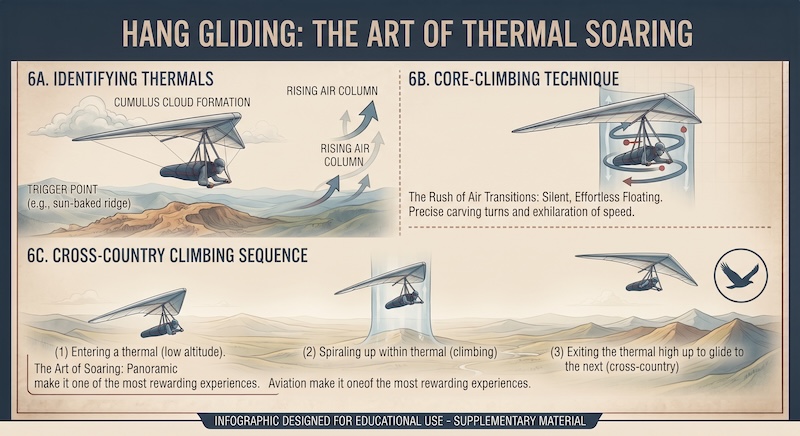
Hanggliding has deeper historical roots than modern paragliding. It traces back to pioneering aviation experiments in the late 19th century by aviation icon Otto Lilienthal, who built and flew gravity-powered hang gliders to study bird flight.
The sport experienced a massive modern revolution in the 1960s when NASA engineer Francis Rogallo invented the flexible, delta-shaped Rogallo wing for spacecraft recovery. Enthusiasts quickly adapted this triangular design into the modern foot-launched hang glider, paving the way for high-performance cross-country soaring.
2. How It Works
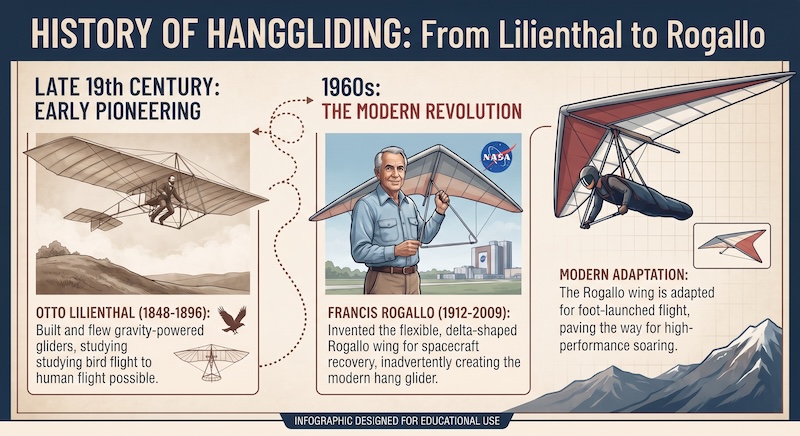
A hang glider is a heavier-than-air, non-motorized aircraft consisting of an aluminum or carbon-composite airframe covered with a high-durability synthetic sail. The pilot is suspended in a prone (lying down) or supine harness from the center of the wing structure.
Unlike paragliders which use soft fabric cells, hang gliders maintain a rigid aerodynamic shape. Steering and control are achieved entirely through **weight-shift mechanics**—the pilot shifts their body weight inside a control frame (the control bar), altering the center of gravity to pitch forward/backward or roll left and right.
3. Aerodynamic Principles
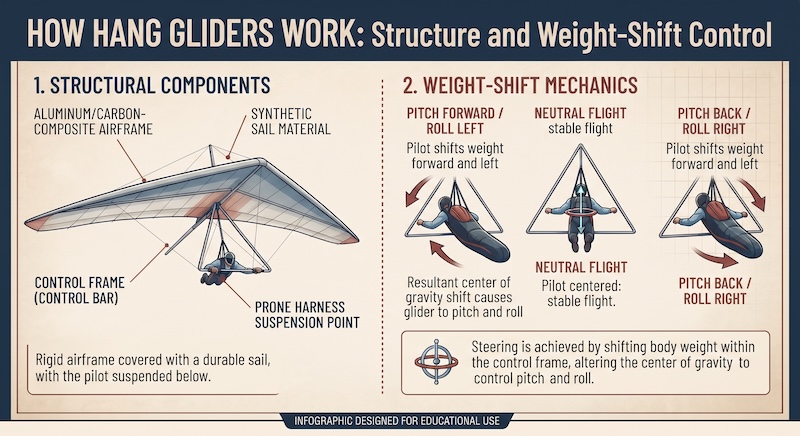
Because hang gliders feature a rigid aerofoil and a higher glide ratio, they operate under strict high-speed aerodynamic physics:
Airfoil Efficiency
The rigid delta shape cuts cleanly through the air, providing a much higher glide angle and speed range than soft wings.
Weight Shift
Translating body mass dynamically across the control frame directly alters the angle of attack and turning radius.
Penetration
Superior speed capability allows hang gliders to punch forward cleanly into strong headwinds or turbulent air.
Stability
Built-in anhedral/dihedral frame geometry offers natural pendulum stability during flight maneuvers.
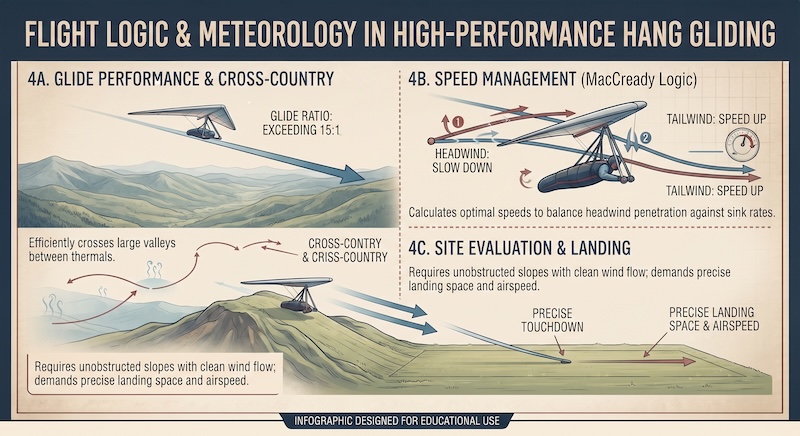
4. Flight Logic & Meteorology
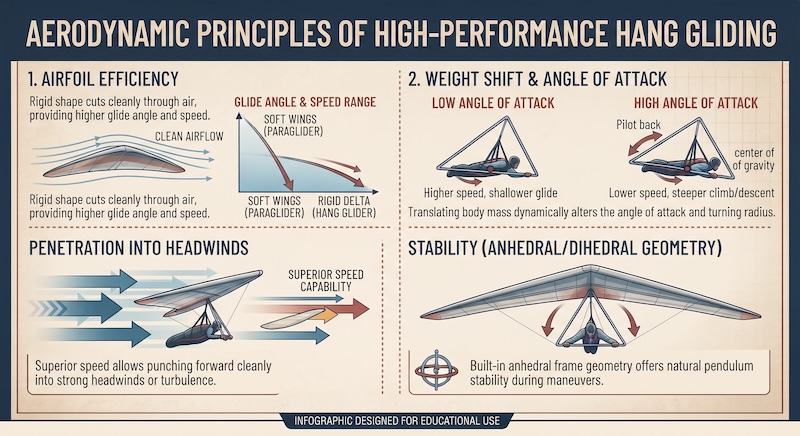
Strategic decision-making in hanggliding focuses heavily on performance velocity and air currents:
- Glide Performance: With glide ratios often exceeding 15:1, hang gliders can travel far across valleys between thermals, making them exceptional cross-country machines.
- Speed Management: Pilots must calculate optimal MacCready speeds to balance headwind penetration against sink rates while transitioning between lift sources.
- Site Evaluation: Launching requires clear, unobstructed slopes with clean wind flow, as hang gliders demand precise landing space and proper airspeed on final approach.
5. Actual Flying Experience
Flying a hang glider feels remarkably like being a bird. Lying prone inside the harness, your body is completely integrated into the wing's movement. As you pick up speed off a launch ridge, the rush of air transitions into silent, effortless floating.
The sensation of speed, precise carving turns, and panoramic vistas make hanggliding one of the most exhilarating and rewarding forms of pure human aviation.