1. History of Paragliding
Early Innovations
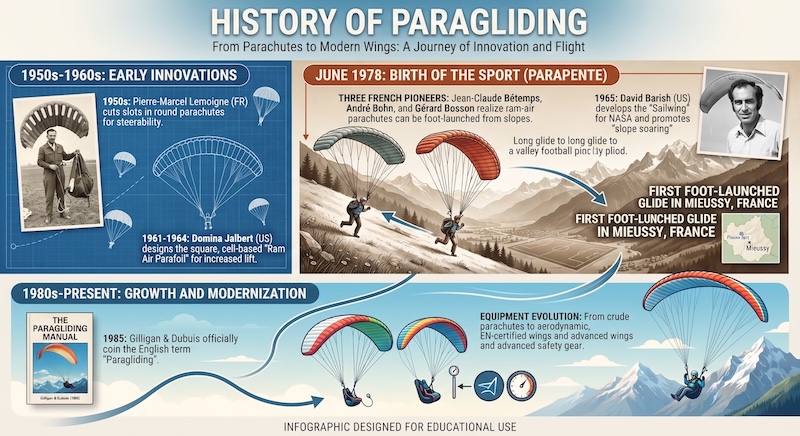
- 1950s: French engineer Pierre-Marcel Lemoigne cut slots into round parachute canopies, allowing air to flow through and making the chute steerable.
- 1961–1964: American inventor Domina Jalbert designed the "Ram Air Parafoil," a square canopy with double surfaces and cells that increased lift and maneuverability.
- 1965: American pioneer David Barish developed the "Sailwing" for NASA space capsule recovery and began promoting "slope soaring" at ski resorts.
Birth of the Sport (Parapente)
Three French friends—Jean-Claude Bétemps, André Bohn, and Gérard Bosson—realized a square ram-air parachute could be inflated by running down a steep slope in Mieussy, France.
- ✔ The First Flight: Bétemps launched from Pointe du Pertuiset and glided 100 meters, while Bohn flew down to a valley football pitch 1,000 meters below.
Growth and Modernization
- 1985: Authors Patrick Gilligan and Bertrand Dubuis published The Paragliding Manual, officially coining the English word "paragliding".
- 1980s–1990s: Equipment changed rapidly as crude parachutes transformed into aerodynamic, EN-certified ripstop nylon wings equipped with advanced harnesses, backups, and variometers.
2. How It Works
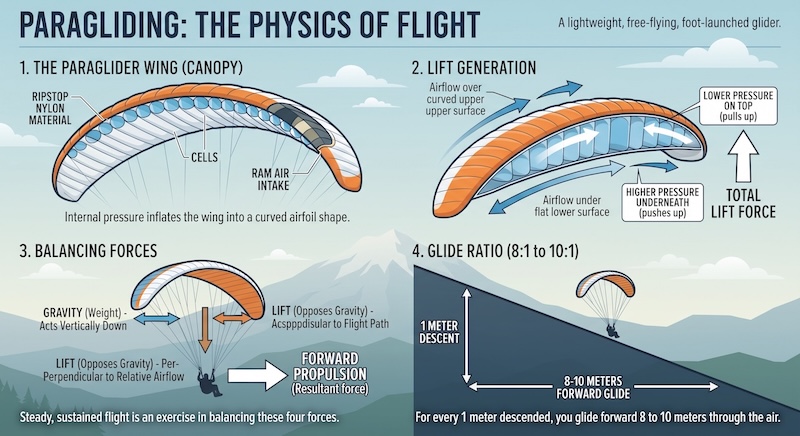
Paragliding is a lightweight, free-flying, foot-launched glider aircraft flying activity. Essentially, it is a sophisticated exercise in balancing aerodynamic lift, drag, gravity, and forward propulsion using a flexible fabric wing (paraglider) and the pilot's own body weight.
How the Physics Works
A paraglider wing (called a canopy) is not a rigid structure; it is an inflatable aerofoil made of ripstop nylon or polyester.
- The Airfoil Shape: Ram air enters open cells at the front of the canopy as the pilot moves forward. The internal pressure inflates the wing, giving it a curved airfoil shape identical to an airplane wing.
- Lift Generation: As air flows over the curved upper surface and underneath the flat lower surface, it creates a pressure differential. The higher pressure underneath pushes the wing up, while the lower pressure on top pulls it up, generating lift.
- Glide Ratio: Unlike parachutes—which are designed purely to slow vertical descent—paragliders are designed for forward flight. A typical recreational paraglider has a glide ratio of about 8:1 to 10:1. This means for every 1 meter you descend, you glide forward 8 to 10 meters through the air.
3. Aerodynamic Principles
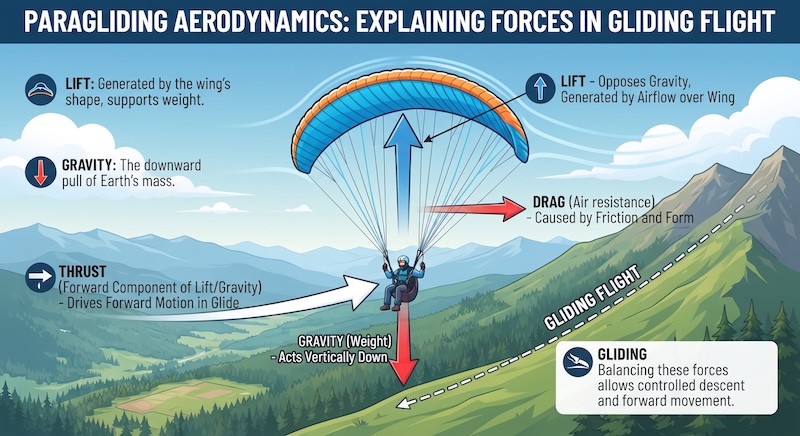
During flight, a paraglider is in a constant dynamic equilibrium governed by four primary forces:
Lift
Acts perpendicular to the relative wind, counteracting gravity and keeping the pilot aloft.
Gravity (Weight)
Pulls the pilot and equipment downward toward the Earth.
Drag
Air resistance acting against the forward motion of the wing and pilot.
Thrust / Glide
Forward thrust is provided by gravity as the pilot descends through the air mass (or mechanical thrust via paramotor).
4. Flight Logic & Meteorology
Because a paraglider is constantly sinking relative to the surrounding air, pilots rely on rising air masses to stay up and gain altitude:
- Thermal Soaring: Columns of warm air rise from the ground after being heated by the sun. Circling inside these invisible pillars lifts the glider upward.
- Ridge Soaring: When horizontal wind hits a mountain or hill, it is forced upward. Pilots can soar back and forth along the windward face of the ridge.
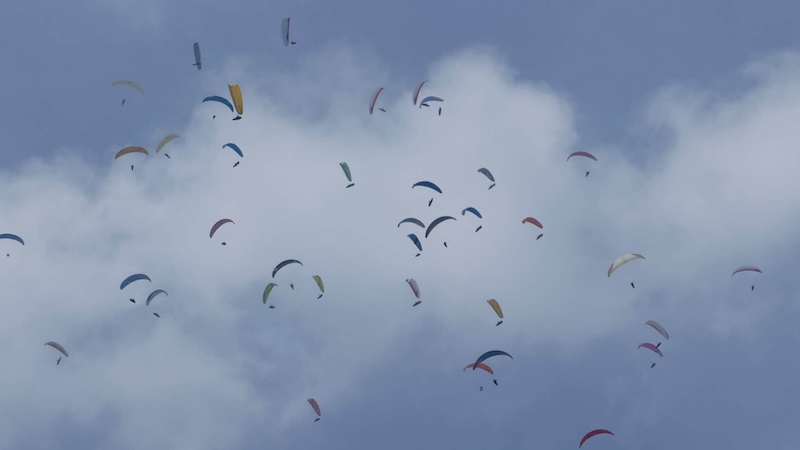
5. Actual Flying Experience
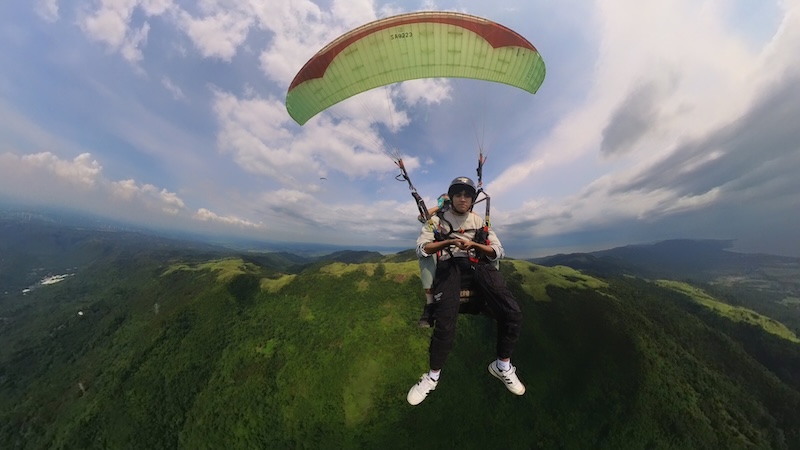
What does it actually feel like? Once airborne, paragliding offers an unmatched sense of absolute peace and freedom. There is no engine noise—only the sound of wind rushing past your ears and panoramic, bird's-eye views of the landscape below.
Whether you are experiencing a gentle tandem joyride with an instructor or piloting your own wing on a cross-country adventure, every flight is a unique connection with nature.